


Have you caught yourself holding your phone farther away to read a text? Maybe a restaurant menu looks really small all of a sudden. You may even be increasing your phone’s font size or taking off your glasses to see up close. If this sounds familiar, you may be wondering is my eyesight suddenly getting worse? You might have heard your eye doctor mention presbyopia, a normal, gradual change in near vision that happens as the eyes age, but what is presbyopia?
What Is Presbyopia and What Causes It?
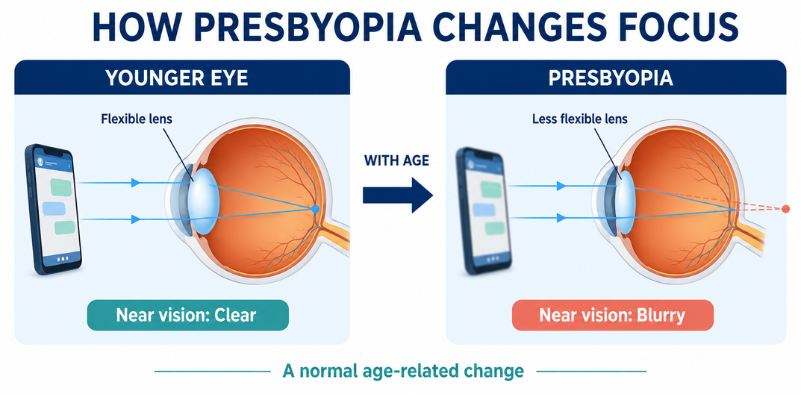
Presbyopia is an age-related focusing change that makes nearby objects harder to see clearly. When you are younger, the lens inside your eye changes shape easily, allowing your eyes to shift focus from a road sign to a phone screen.
Over time, the lens becomes firmer and less flexible, so it cannot focus on close objects as efficiently. These natural changes are the main presbyopia causes, so moving reading material farther away can make the words look sharper.
Age-related presbyopia affects almost everyone eventually, although when it develops and how strongly it affects vision can vary from person to person. Most people begin to notice changes in their 40s, often alongside existing eye conditions such as nearsightedness, farsightedness or astigmatism.
What Are the First Presbyopia Symptoms?

The first presbyopia symptoms can be subtle. You may compensate without realizing it by changing how you hold reading material or adjusting the lighting around you. Common signs include:
- Holding your phone, a menu, or a book farther away to bring the words into focus
- Increasing the font size on your phone, tablet, or computer
- Needing brighter, more direct light for reading or detailed tasks
- Experiencing blurred near vision, especially when you are tired or in dim lighting
- Taking your distance glasses off to read, particularly if you are nearsighted
- Developing eye strain when reading, working at a computer, sewing, or doing other close-up tasks
- Noticing headaches or tired, sore eyes after prolonged near work
These changes often appear gradually. At first, you may only notice them at the end of the day or in a dark restaurant. As the lens continues to lose flexibility, close work may become uncomfortable more often. While these signs commonly point to presbyopia, blurred vision and headaches can have other causes, so it is important not to rely on symptoms alone.
What Are the Best Treatment Options for Presbyopia?

Presbyopia cannot be reversed, but it can usually be corrected effectively. The best option depends on your prescription, work, hobbies, screen use, and preference for glasses or contacts.
Prescription reading glasses are designed for close work. Unlike generic readers, they can account for differences between your eyes and correct other refractive errors. They may suit you if you see clearly at a distance and only need help for reading or detailed tasks.
Progressive lenses combine distance, intermediate, and near vision in one pair of eyeglasses, with no visible dividing line. The upper portion is generally used for distance, the middle for computer-range tasks, and the lower portion for reading. They are convenient if you would rather not switch between pairs. Precise measurements and professional fitting support comfortable vision through each area.
Multifocal contact lenses offer more than one focusing power within each lens to support vision at different distances. They may appeal to active people or those who prefer not to wear glasses. Because comfort and visual demands vary, a professional fitting and trial period are important.
There is no single “best” correction. Someone moving between a computer, meetings, and driving may need a different solution from someone who only wants help with menus or labels. A personalized recommendation can make everyday vision feel more natural.
Why Should You Have an Eye Exam for Blurry Near Vision?
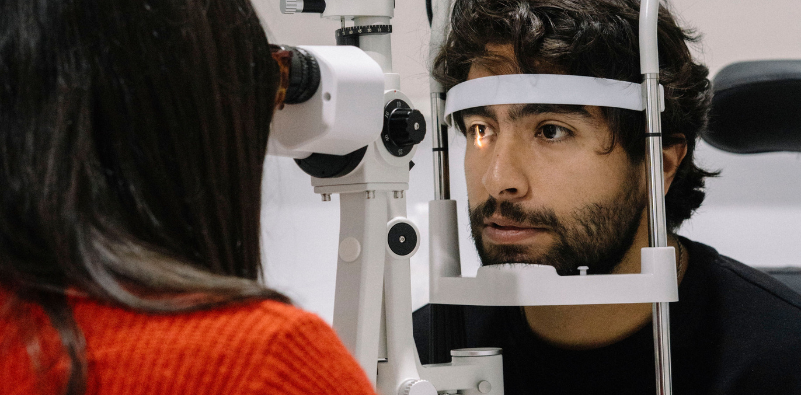
It is tempting to pick up stronger readers and assume the problem is solved. However, blurry near vision can have more than one cause, and your eyes do not always need the same correction. A comprehensive eye exam in Quincy provides a fuller picture of both your sight and your eye health.
An exam can:
- Confirm whether your near-vision change is age-related presbyopia
- Measure your distance and near prescription accurately
- Identify nearsightedness, farsightedness, astigmatism, or other refractive errors
- Evaluate your overall eye health
- Determine which correction is most practical for your work, hobbies, and daily routine
At Kvitle Eyecare Associates, Dr. Jason Kvitle starts by checking your eye health and vision to see what kind of correction you may need. He then walks you through the results and talks about options that fit your lifestyle, work, and everyday activities. The aim is to help you see clearly and comfortably not just in the exam room, but throughout your day.
Are You Ready to Make Near Vision Easier Again?
If menus, messages, or close-up work are becoming harder to see, you do not have to keep stretching your arm farther or pushing through tired eyes. Presbyopia is expected, manageable, and easier to address when your correction is tailored to you.
Contact Kvitle Eyecare Associates to schedule an appointment with Dr. Kvitle in Quincy, Illinois. We will take the time to understand what you are noticing and help you find a comfortable solution for clearer near vision.